Coding Ethos Docs
coding-ethos is policy as code for AI coding agents. It turns a repository’s
engineering principles into generated agent instructions, CEL policy checks,
Git hooks, MCP tools, SARIF output, runtime sandbox evidence, and CI gates.
Current OpenSSF Best Practices status: Silver. Gold readiness and remaining gaps are tracked in the OpenSSF Gold checklist.
Start Here
- README: project overview, quick start, supported agents, and common workflows.
- Repository analysis: source-of-truth boundaries, generated artifacts, and verification model.
- Strategic roadmap: major platform directions for MCP, CEL, SARIF, sandboxing, and agent remediation loops.
- Capability surface decision guide: routing rules for choosing CEL/policy/hooks, generated skills, MCP, CLI, SARIF/code-intel/outputsurface, or provider registries.
- AST/CEL/SARIF architecture: the preferred path for turning parsed source facts into principle-owned CEL policy, stable SARIF, and code-intelligence storage.
- Code intelligence: local DuckDB, duckdb-vss, Tree-sitter chunks, SARIF/remediation evidence, and MCP retrieval surfaces.
- Agent proxy foundation: opt-in proxy trust boundary, provider-neutral event envelope, code-intel ledger, CEL facts, SARIF properties, and operator model.
- Trust signals: OpenSSF Scorecard, Best Practices badge, security posture, and publication checklist.
- OpenSSF Gold checklist:
.bestpractices.jsonevidence, remaining Gold gaps, and remediation plan. - Security assurance case: security claims, evidence, input-validation posture, and known limits.
- Gold security posture: cryptography applicability, TLS verification, site hardening, and release signing.
- Build reproducibility: repeatable build inputs, deterministic Go flags, generated artifact checks, and known limits.
- Supply-chain attestations: Scorecard publishing, GitHub artifact provenance, SBOMs, PyPI Trusted Publishing, checksums, and verification commands.
- Threat model: protected assets, actors, trust boundaries, risks, and out-of-scope claims.
- Release process: versioning, artifact, checklist, and release note expectations.
- Discussions plan: recommended GitHub Discussions categories and issue/discussion boundaries.
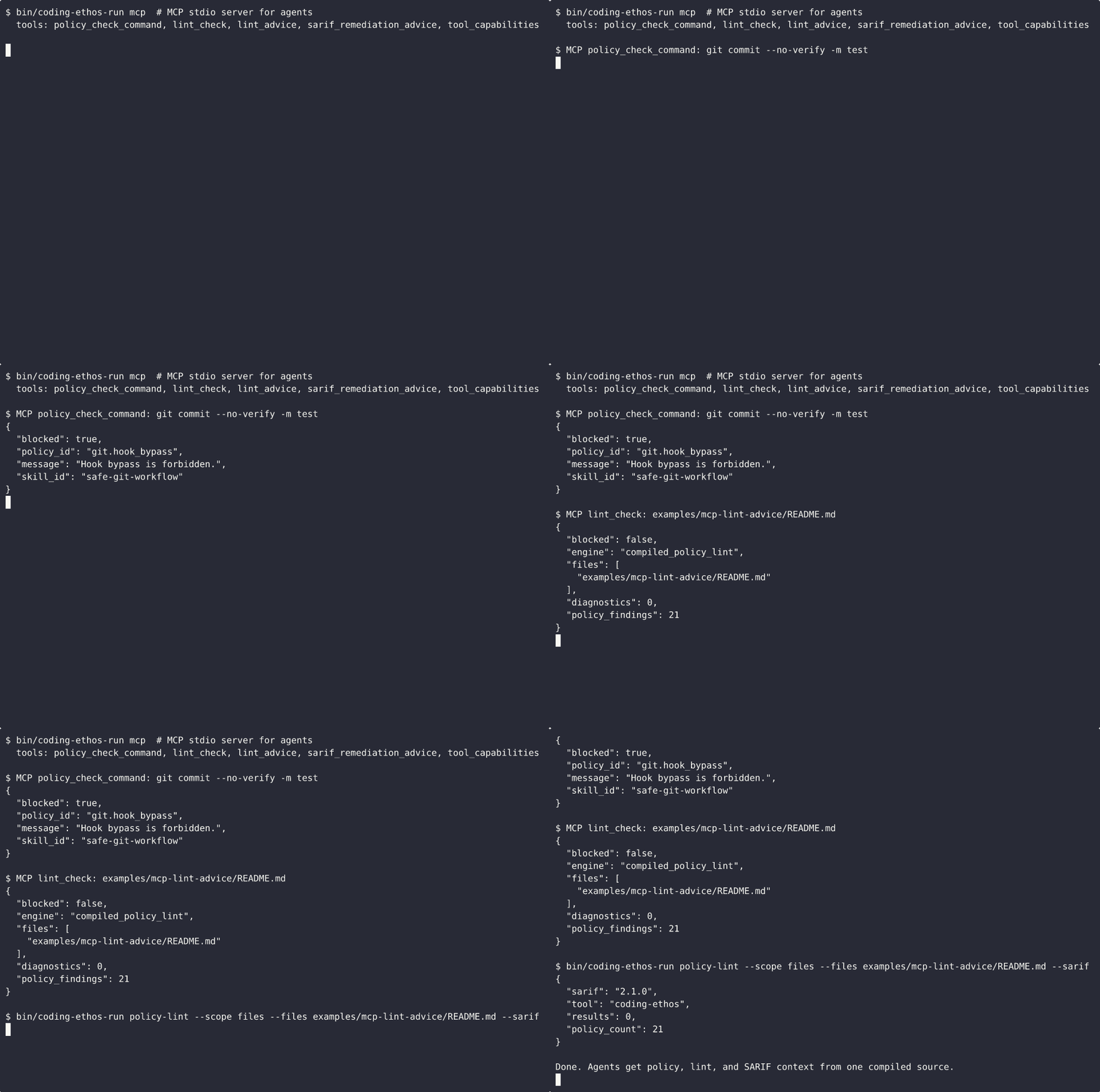
- Demo: verified MCP, command-block, lint-check, and SARIF excerpts plus a recording plan.
- Comparison: how coding-ethos relates to pre-commit, CodeQL, Semgrep, OPA, branch protection, and plain agent instructions.
- Integrations: Codex, Claude Code, Gemini CLI, MCP, GitHub Actions, GitLab CI, SARIF consumers, and managed static analysis.
AI Agent Policy Enforcement
coding-ethos is built for agentic development workflows where Codex, Claude
Code, Gemini CLI, and human contributors need the same enforceable rules.
- Capability surface decision guide: choose the owning public surface before adding new agent-facing capabilities.
- MCP server: stdio MCP tools for policy checks, lint advice, SARIF remediation, risk summaries, and capability inspection.
- Code intelligence: MCP-backed search over stored SARIF, remediation outcomes, hook traces, Tree-sitter chunks, and vector metadata.
- Integrations: setup notes for Codex, Claude Code, Gemini CLI, MCP clients, GitHub Actions, GitLab CI, SARIF consumers, and managed tools.
- Provider capability matrix: generated adapter support, partial-support, unsupported-surface, MCP, memory, and verification coverage by provider.
- Runtime sandboxing: native namespaces, cgroups, seccomp, network isolation, and least-privilege tool capabilities.
- Red-team suite: adversarial coverage for hook bypass, shell parsing, protected paths, MCP framing, SARIF, and sandbox behavior.
CEL Policy Language
CEL lets repos express narrow custom policies without adding a new Go evaluator for every rule. Principle-owned CEL policies live with the ETHOS principle they enforce.
- Policy language strategy: CEL inputs, helper functions, staged migration path, and limits.
- AST/CEL/SARIF architecture: source-fact collection, CEL evaluation, SARIF emission, and code-intel persistence.
- MCP server: policy explanation and policy check tools that expose compiled CEL behavior to agents.
SARIF And Code Scanning
SARIF turns local policy and static-analysis evidence into code-scanning, artifact, trend, and remediation workflows.
- CI/CD SARIF: generated GitHub Actions and GitLab CI gates.
- SARIF uses: remediation advice, risk summaries, trend analysis, editor loops, and policy feedback.
- SARIF editor integration: local workflows for developers and agents.
- Code intelligence: persistent SARIF and AST-backed retrieval for repeated-failure analysis and remediation memory.
Hook And Tool Runtime
- Hook runtime bootstrap: checkout-local runtime artifacts, repair behavior, and consumer hook entrypoints.
- Runtime publication: PyPI generator boundaries and the release-asset model for future compiled Go runtime distribution.
- Lint capture Go flow: managed lint capture through compiled Go request, target resolution, config validation, and normalized output.
- Source docs index: full document list for maintainers.